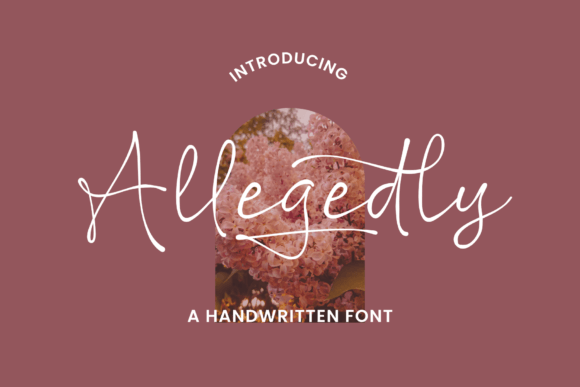
Allegedly: A Script Handwritten Font for Elegant Editorial Moments
It was a quiet Tuesday afternoon—coffee cooling beside my laptop, the final layout for a seasonal lifestyle blog newsletter open in InDesign—when I paused at the headline. The serif body type felt grounded and trustworthy, but the title needed something softer, more intentional. Not playful, not flashy, just quietly confident. That’s when I reached for Allegedly. As a Script Handwritten font, it didn’t shout. It leaned in. And in that moment, it solved the tone problem I hadn’t fully named: how to signal warmth without sacrificing sophistication.
Allegedly for Wedding Invitations and Elegant Branding
Allegedly is a lovely handwritten script font—and its natural writing style carries the kind of effortless grace that makes it ideal for wedding invitations and refined brand identity work. When used for monogrammed stationery or a boutique’s logo lockup, it avoids the stiffness of over-digitized scripts while staying legible at moderate sizes. I tested it in a digital wedding guide PDF: as chapter openers, it gave each section a gentle narrative arc; as watermarks behind soft-focus photography, it added texture without competing. Because Allegedly is a Script Handwritten font with generous spacing and subtle contrast, it breathes well on both screen and print—especially when exported as a high-res PDF or embedded in a Canva template. Just remember: for formal legal text or fine-print details, pair it with a clean sans serif. Allegedly shines where intention matters more than information density.
Allegedly in Newsletter Headers and Social Media Graphics
If you’ve ever spent ten minutes adjusting letter-spacing on an Instagram quote graphic, you’ll appreciate how Allegedly lands with minimal tweaking. As a Script Handwritten font, its rhythm feels human—not algorithmically smoothed, but thoughtfully paced. In a recent creator newsletter header, I used Allegedly for the issue title (“Spring Slow Living”) over a muted linen background. No shadows, no outlines—just the font, sized generously, and it held attention without strain. On mobile, it remained legible at 28pt with sufficient line height. For social media graphics, Allegedly works best as a single-line statement or pull quote—not body copy, not captions. Its charm lies in scarcity: one elegant phrase, perfectly placed. As a Fonts choice for digital-first content, it rewards restraint.
Allegedly for Pull Quotes and Chapter Openers in Ebooks
In a 40-page recipe ebook I designed last month, Allegedly became the quiet anchor for every chapter opener and pull quote. Not for the recipes themselves—those stayed in a warm, highly readable serif—but for moments where voice mattered most: “This cake tastes like Sunday mornings,” set in Allegedly, then followed by precise ingredient lists in Garamond. That contrast created hierarchy without friction. As a Script Handwritten font, Allegedly adds personality without overwhelming structure. It’s not overly decorative, nor does it mimic calligraphy tools too literally—so it scales well from 18pt ebook headings to 36pt cover titles. Just verify your file includes OTF or TTF formats before embedding in EPUBs or PDF exports; commercial licensing is essential if you’re selling the ebook or distributing it via email list.
Allegedly for Printable Planners and Coaching Workbooks
When designing a printable coaching workbook—think reflection prompts, guided journaling pages, and gentle section dividers—I chose Allegedly for all non-functional text: titles, subheadings, and short inspirational lines. Why? Because as a Script Handwritten font, it subtly signals invitation rather than instruction. Readers don’t feel directed; they feel welcomed into the space. It pairs beautifully with a light sans serif (like Inter or Lato) for checkboxes, dates, and instructions—creating visual breathing room. In printed form, Allegedly holds up well on matte paper, especially at 20–24pt. Avoid using it for tight grids or dense tables, though: its expressive flow needs space to land. And always check whether the Fonts package includes stylistic alternates or ligatures—if you’re hand-lettering a custom watermark or monogram, those extras add polish.
What Allegedly Is Not Designed For
Let’s be clear: Allegedly is not a body text font. It’s not meant for long-form reading, footnotes, image captions under 14pt, or data-heavy spreadsheets. As a Script Handwritten font, its strength is mood, not utility. If your editorial layout relies on rapid scanning—think news digests, academic summaries, or technical documentation—Allegedly will slow readers down, not guide them. Likewise, avoid it for accessibility-critical contexts unless paired with strong alt-text and fallback fonts. And while it’s lovely for branding, don’t assume it works across all platforms: some email clients render custom Fonts inconsistently, so always test renders before sending. Use Allegedly where you want resonance—not resolution.
How to Pair Allegedly With Other Fonts for Editorial Design
The real magic of Allegedly emerges in pairing. As a Script Handwritten font, it thrives alongside typefaces that ground its lyricism. Try it with a warm serif (like Merriweather or EB Garamond) for ebook titles and body text—serif provides rhythm, Allegedly provides voice. Or pair it with a neutral sans serif (like Poppins or Montserrat) for navigation, labels, and captions—sans brings clarity, Allegedly brings character. For printables or PDFs, ensure your Fonts license permits embedding and redistribution. And if you’re building templates for others—say, Canva layouts or Notion workbooks—confirm commercial use rights upfront. Allegedly isn’t just a font. It’s a deliberate editorial decision—one that says, softly but surely: this moment matters.