Hair Color Script Handwritten Font for Unique Brand Designs
It started with a blank brand board—soft beige background, muted palette swatches, and three handwritten font options open in my design app. I was refining the visual identity for a local ceramicist’s new studio line: hand-thrown mugs, minimalist packaging, quiet confidence in every detail. Her voice is warm but precise; her work feels intentional, not whimsical. So when I dropped Hair Color onto the logo draft—just “Clay & Co.” in all lowercase—the room shifted. Not dramatically. Just… settled. Like the font knew exactly where it belonged.
Hair Color for Logo Design and Studio Brand Identity
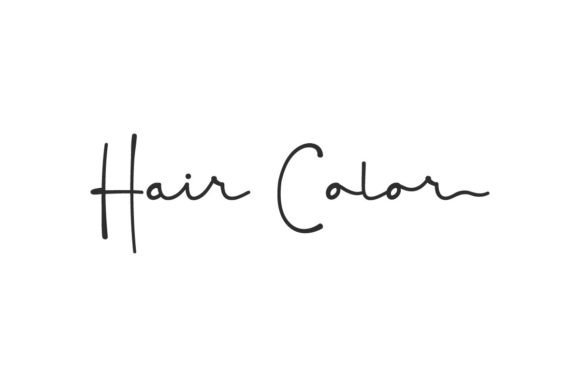
Hair Color is a Script Handwritten font that leans into natural rhythm without sacrificing neatness. It’s not overly looped or exaggerated—it avoids the “calligraphy class” energy some script fonts carry. Instead, Hair Color has gentle entry strokes, relaxed exits, and subtle variation in stroke weight that reads as human-made, not algorithmically smoothed. On a logo lockup (especially at 36–60pt), it holds presence without shouting. I tested it against two other popular Fonts in the same category: one too tight and angular, another too flourished for small-scale applications. Hair Color sat comfortably between them—casual enough for a handmade pottery studio, polished enough to hang beside serif body text on a business card or website header.
Hair Color on Packaging Labels and Product Mockups
Where Hair Color really surprised me was on matte-finish kraft paper labels. I mocked up a set of 2.5" x 3.5" product tags for her mug collection—“Stoneware • Wheel-thrown • Small Batch”—and set the descriptors in a clean sans serif, but used Hair Color for the product name itself. The contrast worked because Hair Color’s natural style didn’t compete with the texture of the paper—it complemented it. No ink bleed, no legibility drop at 14pt on print. That said: don’t use Hair Color for ingredient lists or fine print. It’s a display font, not a text font. Its strength lies in short, evocative phrases—not paragraphs. As a Script Handwritten typeface, it thrives where personality matters more than density: shop signs, jar labels, greeting cards, Instagram story headers.
Hair Color for Social Media Graphics and Web Headers
I dropped Hair Color into a homepage hero section next to a neutral sans serif (Inter, regular weight). At 48px on desktop and 32px on mobile, it remained crisp—even as a webfont. No jitter, no rendering lag. For social media, I used it sparingly: once per post, usually for a single word like “Handmade” or “New” overlaid on a neutral photo. It added warmth without clutter. But here’s the practical note: Hair Color doesn’t include multiple weights or italics. It’s a single-style Fonts file—so if your system relies on bold/regular differentiation for hierarchy, pair it intentionally. I paired it with a sturdy serif (Cormorant Garamond) for quotes and a friendly geometric sans (Poppins) for captions. That trio created breathing room while keeping the voice cohesive.
Hair Color for Wedding Invitations and Elegant Branding
Yes—Hair Color works beautifully for wedding stationery, but not because it’s ornate. It’s elegant in its restraint. Think ivory linen envelope + blind deboss + Hair Color for the couple’s names. No swashes, no ligatures, no alternate characters built in—but that’s part of its charm. It doesn’t distract from the moment. It supports it. As a Script Handwritten font, Hair Color delivers natural style without demanding attention. That makes it ideal for brands that want sincerity over sparkle: artisan bakeries, slow-fashion labels, independent bookshops, herbal apothecaries. If your client values authenticity over trend-chasing, Hair Color fits like a well-worn apron.
Hair Color in Real Projects: What to Test Before Final Use
Before locking Hair Color into final files, test it in context—not just as a standalone sample. Try it:
- At 10pt on a printed business card (it’ll likely blur—stick to 12pt minimum for print)
- In all-caps on a dark background (some letters tighten visually—check spacing)
- Next to your primary sans serif in Figma or Illustrator (look for vertical rhythm alignment)
- As a webfont across Chrome, Safari, and Firefox (Hair Color renders cleanly, but always verify)
Also: check the license. Hair Color is a commercial Fonts file—you’ll need an extended license for templates, merchandise, or SaaS platforms. For client branding work, a standard desktop license covers logos, packaging, and static web use. But if you’re building a Shopify theme or Canva template? Double-check. Nothing derails trust faster than a font licensing surprise mid-project.
Hair Color isn’t flashy. It won’t dominate a trend report. But it’s the kind of Script Handwritten font that earns repeat use—not because it’s loud, but because it’s reliable, human, and quietly confident. If your next project needs a voice that feels like a thoughtful note passed across a counter, not a megaphone announcement—Hair Color is worth your time.